
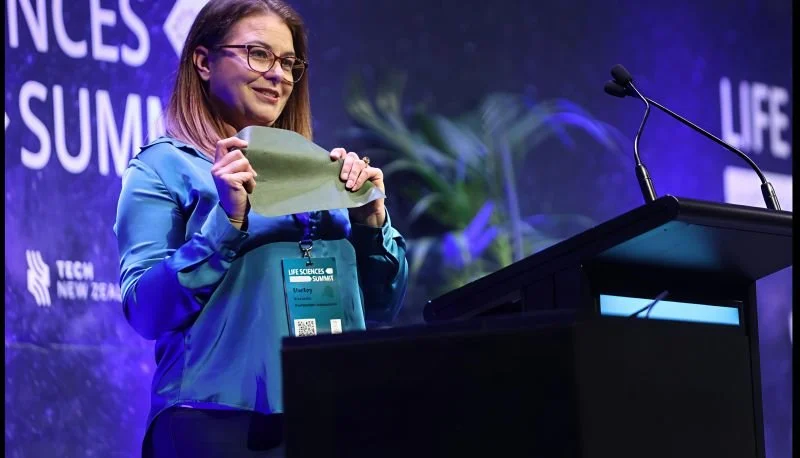
Shelley Houston had spent five years developing a leather alternative made from kiwifruit waste. Plastic-free. Plant-based. Scalable. Designed to replace traditional leather across industries like fashion and automotive. It started in her kitchen, but it didn’t stay there for long.
“I just started playing around with it. And it worked a lot better than I thought it would.”
This wasn’t her first time building something from scratch. She’d already created a makeup brand, taken it to international manufacturing, and seen it used at Paris Fashion Week, New York Fashion Week, and featured in British Vogue. She understands how to take an idea, shape it, and push it further than most people would. Kiwi Leather Innovation is that same instinct, applied to a much bigger opportunity.
But this time, the challenge wasn’t just building the product. It was understanding the market around it.
The challenge
The business was still early. Deep in R&D, refining the material, improving performance, and proving what it could become. Shelley had done the hard part most people never get through. She had something real, something working, and a deep, hands-on understanding of how it all fits together.
She wasn’t guessing. She was building with intent.
But building the product is only part of it.
The harder question was everything around it. Where this fits, who actually buys it, how the market is forming, and where the real opportunity sits.
“I’d kind of gone in thinking about these sort of things… but it just shows all the different possibilities out there.”
Like most founders operating at this level, she was inside it every day. Making progress, solving problems, moving things forward. The depth was there. What was missing was the full view of the space she was stepping into.
And in a category that’s still emerging, that’s not a small gap. It’s the difference between building something interesting and building something that scales.
Why she did the Market Scan
There wasn’t a single trigger. No crisis. No obvious gap. Just a clear sense that there was more to understand.
She’d seen what a Market Scan could do. Heard about it through her network. Then went through an accelerator where it came up again. That reinforced it.
“I was already leaning that way. The accelerator just confirmed it.”
She wasn’t looking to change direction. She wanted to understand where her business fits in the market, and where the real opportunity was.
What we found
Shelley already had strong instincts about the direction of the business. The role of the Market Scan was to build around that. To test it. Extend it. Pressure it.
We mapped the space properly. Globally. Not just the obvious players, but the full ecosystem around next-generation materials.
What came back was reassuring.
“A lot of it was what I was thinking… which was quite good to know I was on the right track.”
That matters. Because it confirmed that her thinking wasn’t just creative. It was commercially grounded.
But the real value came at the edges.
New players she hadn’t come across. New types of organisations operating in the space. New ways the market was evolving.
One stood out in particular. A global materials company she hadn’t encountered before.
“That was a really big door opening for us.”
That’s what perspective does. It doesn’t replace what you know. It extends it. It connects what you’ve built to what’s happening around you.
Because even when you’re experienced, even when you’ve done the work, you can’t see everything from inside the business.
“You kind of have tunnel vision… you see what you want to see.”
What changed
The business didn’t pivot. It strengthened.
The Market Scan gave Shelley a more complete picture of where she sits and how to communicate it. Not just as a product, but as a credible, investable opportunity.
She now takes that work into investor conversations, into grant applications, and into strategic discussions. It backs up what she already knows with something others can see.
“Look, this is what we’ve been working towards… we’re right in our thinking, but now we have the data to prove it.”
That detail is the difference. Especially at this stage. It turns belief into something others can understand and get behind.
The timing mattered.
“It gave us a solid foundation for what we’re doing this year.”
The result
The business is still early. Still building. Still evolving. But it’s operating from a stronger place.
More grounded. More visible. More connected to the market it’s entering.
Shelley didn’t need direction. She already had that. What she needed was a clearer view of the space she’s stepping into, and how to position what she’s built within it.
What changed wasn’t her instinct or her work ethic. That was already there.
What changed is what sits behind it.
Clarity. Context. Confidence that the direction she’s been building toward stands up, not just technically, but commercially.
That’s the shift. From building something unique, to knowing exactly where it fits and how far it can go.